If you were initiated into the world of fitness under the tutelage of a high school P.E. teacher or a personal trainer at a massive commercial gym franchise, the leg extension may be the first resistance exercise for legs that you’ve encountered. The reason for this is because educators are often paranoid about trainees getting injured on their watch, and leg extensions are among the simplest and safest leg exercises to learn in a controlled fitness environment.
While most tried-and-true methods for training legs with weights require multi-joint movement, leg extensions only necessitate the straightening of a previously bent leg against consistent resistance. Given the simplicity and effectiveness of leg extensions it isn’t shocking that you would relish an opportunity to reliably perform them in your home gym without having to swipe an entire leg extension machine and secretly stash it in your garage.
Your only hurdle now is figuring out how to accomplish this leg-training mission and beef up your workout program.
What Is a Leg Extension?
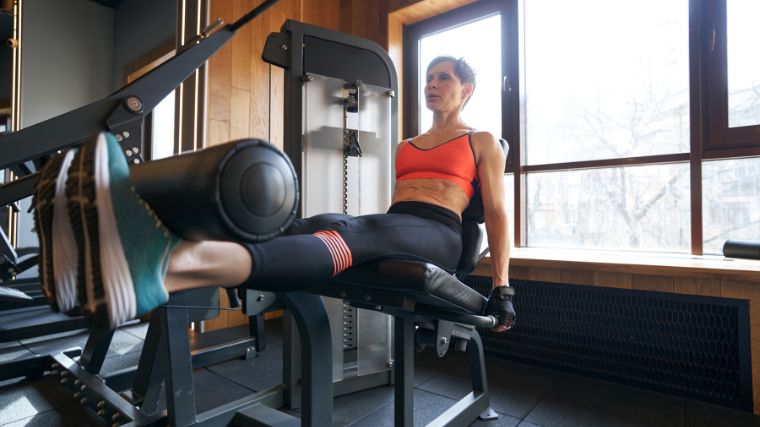
As the majority of gym-goers would understand it, a leg or knee extension is an exercise that requires you to sit upright at a cushioned machine with a padded back support. From there, you would bend your legs at the knee and slide your shins behind a pad that is connected to a cable. By extending your leg outward and upward from the knee, you could then train your quadriceps muscles with constant resistance provided by the cable system.
In this format, leg extensions are one of the rare lower-body exercises that isolates the quadriceps muscles almost completely as opposed to leg exercises that incorporate the glutes and hamstrings. While there are advantages to training your leg muscles collectively, and against the direct force of gravity, there is certainly something to be said for isolating each section of your legs and focusing all of your attention on forcing them to grow. That’s why you should never accuse the leg extension of being just for beginners, or somehow unnecessary.
How to Do It
- Sit at a leg extension machine by sliding your feet and shins into place behind the pads, and ensure that your upper and lower legs form a 90-degree angle.
- Straighten your legs by pushing against the shin pads while maintaining your securely seated position at the machine.
- Pause briefly at the top of the movement, then slowly allow your legs to bend once again to return to the starting position.
How to Do Leg Extensions at Home
Due to the ease with which they can be affixed to an ordinary weight bench, a leg extension attachment is a frequent inclusion on many benches that are purchased for home use. These units commonly include a protruding rod for securing standard weight plates. However, if you don’t own a weight bench that allows for one of these attachments, that doesn’t mean you won’t be able to mimic the range of motion of a leg extension machine in other ways during your workout routine.
Here are a few leg extension alternatives you can perform in your home gym:
Dumbbell Leg Extension
A dumbbell leg extension is performed by holding a dumbbell between your feet while your knees are bent and maintaining that hold on the dumbbell while you straighten your legs. In order to simplify such alternative exercises, foot-worn devices like MonkeyFeet have been designed as specialized dumbbell holsters that prevent you from having to concentrate on stabilizing the weight between your feet.
[Read More: The Complete Guide to Pre-Workout Supplements]
How to Do It
- Sit at a flat surface with both legs bent at a 90-degree angle, with a dumbbell placed either between your feet, or attached to your specialized dumbbell-holding device.
- Straighten your legs to raise the dumbbell until your legs are parallel to the floor.
- Pause briefly at the top of the movement, then slowly bend at your legs to return your feet and the dumbbell to their starting position.
Banded Leg Extension
As a comparatively inexpensive alternative to free weights and specialized machines, a resistance band can provide a reliable and stable solution to add resistance to your home leg extensions. In practice, you can simply slip one loop of the band securely around your weight bench and the other around the ankle of your active single leg. From there, you can extend your leg as you ordinarily would and resist the pull of the band as you return to your starting point.
[Read More: The Best Foods for Energy Before, During, and After Your Workouts]
How to Do It
- Sit at a weight bench or a chair with both legs bent at a 90-degree angle, with a resistance band anchored to the support leg of the chair you’re sitting on, and with one loop of the resistance band placed around your right ankle.
- Straighten your right leg by pushing against the resistance of the elastic band.
- Slowly return your right leg to its starting position.
- Switch legs at the conclusion of the set.
Manual Leg Extension
You don’t need any weights at all to train your quads at home. In fact, all you need is a willing assistant. The manual leg extension is exactly what it sounds like — resistance is applied manually by another person against which you straighten your knee. This version provides consistent tension to your quads, but does rely heavily on having a competent and attentive “spotter.”
[Related: What Is Manual Resistance Training?]
How to Do It
- Sit on the edge of a chair, table, or desk and hang your shins off it.
- Have your partner grab one or both of your shins, clasping their palms across the front of your ankle.
- From here, perform a leg extension and encourage your partner to resist your movement.
Benefits of Leg Extensions
Collectively, your legs are the largest muscle group in your body, so there are going to be some massive performance benefits that are going to come your way as a result of a regular leg workout. All the same, there are some specific advantages that you will enjoy through training your legs with leg extensions, whether you perform them using a dedicated machine at the gym or through your own method at home.
Quadriceps Strength
With most other leg-based exercises, there is usually a sharing of the burden of supporting and moving the weight. This often lends itself to the confusion of exercisers as to precisely which muscles are receiving adequate resistance. The arrangement of the leg extension ensures that the overwhelming majority of the tension from the exercise is absorbed within your quadriceps muscles.
Easy Drop Sets
In order to rapidly drop the weight being lifted in most leg-focused compound exercises, it can be a near requirement to have at least one spotter or assistant present to help you swiftly remove plates from a weight bar, if not more than one. Many variations of leg extension machines feature a device configured to have resistance added or removed, like a selector pin. In that respect, leg extensions can be a very reliable tool for training legs to absolute failure, which is something you might be reluctant to do if you have hundreds of pounds resting on your shoulders and no one around to assist you.
A Pain-Free Back
The majority of the popular power-building leg exercises are compound movements that enable trainees to quickly progress to the point where their bodies can often support several hundreds of pounds. Yes, these exercises can yield impressive results, but they also place incredible stress on your spine, and particularly on the discs in your lower back (not to mention the risk of knee pain). Isolating your quadriceps through leg extensions may slow your growth of mass and strength, but it can also provide relief to the muscles of your posterior chain. This can be especially valuable as you age or if you are recovering from an injury.
Leg Extension Alternatives
Even if you lack easy access to a device that enables you to perform quality leg extensions at home, you can still achieve very thorough quadriceps training by using one or more of the following time-tested exercises.
Squat
[Read More: The 8 Best Knee Sleeves You Can Buy (Spring 2023 Update)]
The combined act of elevating and supporting weight on a bar held aloft by your shoulders, bending at the knees to lower it toward the ground, and then pressing it back to its starting position forces your legs into extension. Even though this is not an isolation exercise like the leg extension, the elevated load carried by your legs during a squat transforms it into a tremendous developer of your quads.
Deadlift
[Read More: Best Posture Correctors The Provide Posture Support]
Even though a barbell usually begins on the ground during a deadlift, the movement pattern of your body is effectively the same as during another compound exercise like the squat. Your quadriceps strain mightily as you extend from the knees and straighten your body into an upright position against the force of gravity. Again, this forces all of the muscles in your quadriceps to be involved in the pulling action.
Leg Press
[Read More: The Best Online Workout Programs For Coaching, Cardio, Value, And More]
As an open-chain approximation of the squat, in which your legs move the weight away from your body, the leg press exercise usually places weight on an angled sled and requires you to press against the supplied resistance. The straightening of your legs during the outward press activates and develops your quadriceps. As effective as this exercise is, a leg-pressing device is even less common in a home environment than a leg extension machine is.
Lunge
[Read More: The Best Healthy Fast Food Options at the Most Popular U.S. Chains]
While lunges have customarily been performed with one dumbbell held on each side of the body, they can also be completed with a barbell on your shoulders as if you were doing squats. Whether you step forward or backward, the act of bending at the knees and pressing off of a single leg causes your quadriceps to extend your leg against resistance, strengthening your quadriceps in the process.
Planking Leg Extension
[Read More: Build a Titanic Torso with These Bodybuilding Chest & Back Workouts]
While this movement will train your quads similarly to seated leg extensions, it will also place incredible tension on your abdominals and hip flexors as you attempt to stabilize your body throughout the process. To perform this exercise, you’ll place your body in a plank position with your knees bent and your feet resting on an elevated surface, like a weight bench, chair, or couch. While maintaining a plank position with straight arms and a rigid torso, you can press through the tops of your feet to straighten your legs into a fully extended position, using your body weight as resistance.
Final Takeaway
Beginners and seasoned lifters alike should take note. Leg extensions are a valuable quadriceps exercise, and you needn’t consider yourself to be at the mercy of a commercial gym’s operating hours to be able to do them during your leg workout. No matter how much money you have to invest in leg extensions—even if it’s zero dollars—there is an approach to training with leg extensions at home that will fit easily within your budget, even if all that training leaves your legs struggling to fit within a pair of pants.
FAQs
If you have additional questions about how to perform leg extensions at home, you can rest assured that we’ve got some answers that will have you strengthening your quads in no time!
How can I do leg extensions at home without a machine?
Between free weights, special devices, exercise bands, or even with resistance provided by your own body, there are several ways to perform leg extensions without any assistance from a machine.
What is a good substitute for leg extensions?
If your goal is to train the muscles in your quadriceps, there are several great alternatives to leg extensions. These include squats, deadlifts, leg presses, and lunges, along with relatively unorthodox movements like planking leg extensions.
What are the benefits of doing leg extensions?
Leg extensions strengthen the front of your legs by isolating the muscles in your quadriceps. For many lifters, this is the preferred way of training their quads because it typically permits them to apply resistance directly to the muscles being targeted. This can also negate the need to place your entire body under the pressure of heavy weights through multiple reps of squats and deadlifts, resulting in the lifting of hundreds of pounds at a time.
Featured Image: YAKOBCHUK VIACHESLAV / Shutterstock
The post How To Do Leg Extensions At Home Without A Fancy Machine From The Gym…Or Any Machine At All appeared first on BarBend.
from BarBend https://ift.tt/v5uWlVa
via IFTTT
Comments
Post a Comment